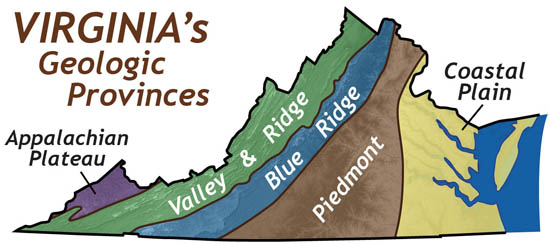
The Blue Ridge is one of several geologic regions in Virginia. The Appalachian Mountains, of which the Blue Ridge form a part, are among the oldest mountain ranges on earth.
The present-day Appalachians are the last of several ranges that have appeared in this area over the past billion years or so.
Since the Blue Ridge is part of Appalachia, here’s a video:
Below is a very good, non-technical introduction to the geology of the southern part of the Appalachian Mountains.
Allison Hammer’s page on the geology of Virginia goes into more detail, but is still readable. It also has a lot of excellent maps and diagrams.
Page about the Blue Ridge from William and Mary; shows geological cross section.
Fossils and Gemstones
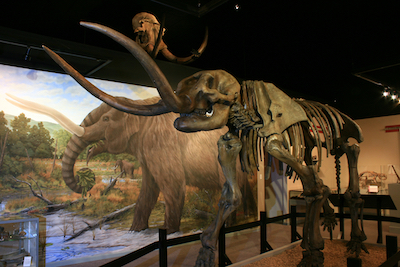
While not as rich in fossil deposits as some other areas, Appalachian Virginia has its own collection of remains of ancient life. Perhaps the most celebrated fossils are the remains of Ice Age mammals, including the mastodon in the photo here, discovered near Saltville, in Smyth County. They are on display at the Museum of the Middle Appalachians.
For a more general discussion of fossils in the Blue Ridge, see the Fossils of the Blue Ridge and Piedmont page from the Paleontological Research Institution.
If you’re more interested in gold and gemstones than fossils, the video below gives an overview of locations for finding gold, rubies, sapphires, emeralds, and other precious and semi-precious gems and minerals in the Piedmont and Blue Ridge regions of North Carolina.
End with a Song
Finally, here’s what must be one of the very few country songs about geology and Appalachia, sung by Glen Dale, West Virginia native and multiple Grammy Award winner Brad Paisley on A Prairie Home Companion.
 Suzann Albright